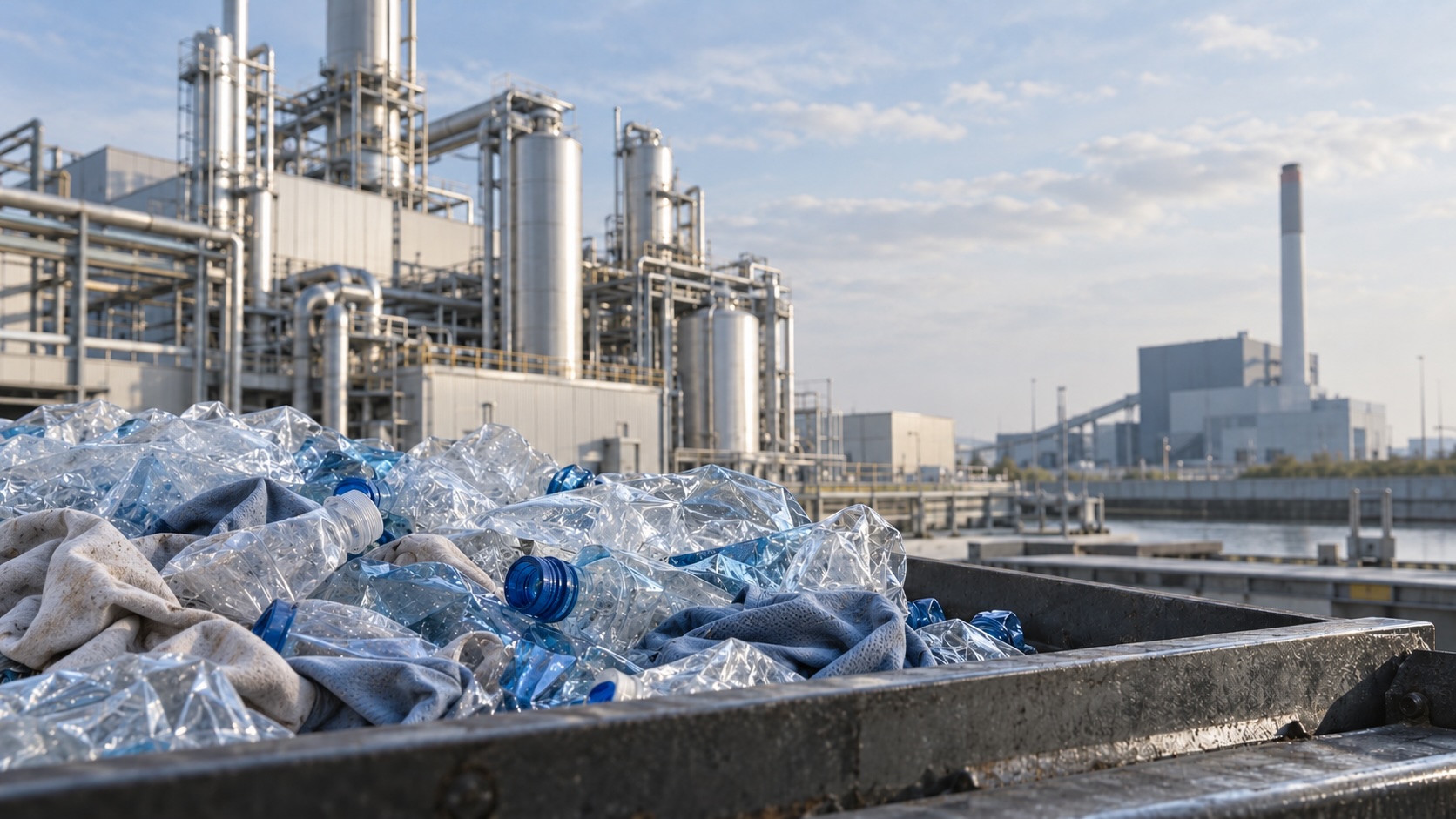
The European Union is preparing to extend emissions trading to waste incineration. The proposal also covers pyrolysis and gasification where their outputs are subsequently incinerated. The change could strengthen the economic position of technologies that return waste to the material cycle. These include RECIVONE’s patented molecular recycling technology for PET and polyester, whose product outputs consist exclusively of monomers and recycled fertiliser.
The proposal to revise the EU ETS, presented by the European Commission on 17 July 2026, raises a fundamental question for European waste management: how waste treatment prices should also reflect its climate impacts. The Commission proposes to include the incineration and co-incineration of non-hazardous waste in installations with a capacity exceeding three tonnes per hour. The cost of emissions allowances would therefore gradually become part of the operating costs of municipal waste-to-energy plants. Newly covered installations would be required to surrender emissions allowances progressively: for 25 per cent of the relevant verified emissions reported for 2031, 50 per cent for 2032, 75 per cent for 2033 and 100 per cent for 2034 and each subsequent year.
Two letters, two perspectives on the future of waste management
The political and economic debate surrounding the change is illustrated by two open letters published on 29 September 2026. In the first, businesses, industry associations and environmental organisations call for waste incineration to remain included in the proposed revision. They argue that carbon pricing would reduce the incineration of recoverable materials and strengthen investment in waste prevention, reuse and recycling. They also link greater availability of secondary raw materials to the competitiveness of European industry and reduced dependence on primary resources.
The second letter was signed by representatives of local authorities, municipal utilities, waste treatment operators, district heating providers and other energy users. They call for waste incineration to be excluded entirely from the proposed extension. They highlight its role in treating residual waste and supplying heat. They anticipate higher waste service and energy prices and question whether emissions allowances would provide sufficient incentives to reduce emissions. At a carbon price of €100 per tonne of CO₂, they estimate additional costs of almost €4 billion annually; this is the group’s estimate, rather than a uniform cost applicable to every incineration plant.
For recycling, the subsequent use of outputs is decisive
For chemical recycling, the distinction between material recovery and fuel production is crucial. The proposal explicitly states that chemical recycling, including thermal processes such as pyrolysis and gasification, is excluded from the extension to the extent that its outputs are not subsequently incinerated. This follows the definitions of incineration and co-incineration in the Industrial Emissions Directive, which also cover thermal waste treatment processes whose resulting products are subsequently incinerated.
For an installation supplying part of its output for the production of new plastics and part for fuel production, these two streams must therefore be distinguished. Material output intended for polymer production is separate from the fuel fraction, and its carbon is not combusted at this stage. However, producing feedstocks for new polymers alongside fuel outputs does not, in itself, establish an exemption for the entire installation. Specific obligations will depend on the installation’s boundaries and the emissions monitoring rules. The existing Waste Framework Directive already excludes the reprocessing of waste into fuels from the definition of recycling.
RECIVONE returns PET and polyester to the material cycle
RECIVONE’s technology is not pyrolysis. It is a patented molecular recycling process based on the alkaline hydrolysis of PET and polyester. It breaks down the polymer into two monomers – terephthalic acid and monoethylene glycol – which serve as raw materials for the production of new PET and polyester. Recycled nitrogen fertiliser is produced simultaneously within the same integrated process. Monomers and recycled fertiliser account for 100 per cent of the product outputs. The technology never produces fuel. Its business model therefore rests on the sale of usable products and the return of raw materials to manufacturing.
This material recovery principle places RECIVONE outside the proposed extension of the EU ETS to waste incineration and co-incineration. The decisive factor is not only its distinction from pyrolysis, but above all the fact that the process converts PET and polyester into raw materials for further material use. The company is currently preparing to validate the technology under industrially relevant conditions and to scale it up.
Alongside mechanical recycling, RECIVONE offers a route for suitable PET and polyester feedstocks where colour, degradation or quality requirements limit mechanical processing. It is not a universal solution for mixed municipal waste: the technology requires appropriate PET and polyester streams. For holders of these waste streams, however, it expands the options for keeping materials in circulation and recovering further value from them.
Changing economics for municipalities, waste suppliers and investors
Including waste incineration in the EU ETS could increase waste treatment costs. The extent of the impact will depend primarily on the volume of fossil-derived emissions, the price of emissions allowances and the gradual phase-in of the obligation. The extent to which these costs are passed through to waste service and heat prices will also depend on contractual and market conditions.
This creates a potential economic opportunity for recycling projects. If emissions costs increase the price of incinerating recoverable plastics, separating them and directing them to material recycling could become more advantageous. The competitiveness of an individual plant will depend on its feedstock, energy and chemical prices, and market demand for the recovered raw materials.
Combined with restrictions on landfilling and pressure to reduce the incineration of recyclable materials, this creates a clear rationale for expanding recycling capacity. Mechanical recycling and suitable molecular recycling technologies can offer complementary solutions for feedstocks of differing quality. RECIVONE aligns with this direction through the material recovery of waste PET and polyester.
The revision has not yet been adopted. The proposal also provides for conditional national exemptions from the obligation to surrender emissions allowances until the end of 2035. Its final wording will be subject to further negotiations at European level, while individual Member States will address the possible use of exemptions. For long-term investment, however, the direction of the debate already matters: keeping raw materials in circulation is set to receive a stronger economic incentive.
By Lenka Linhartova, Co-founder & CEO of RECIVONE