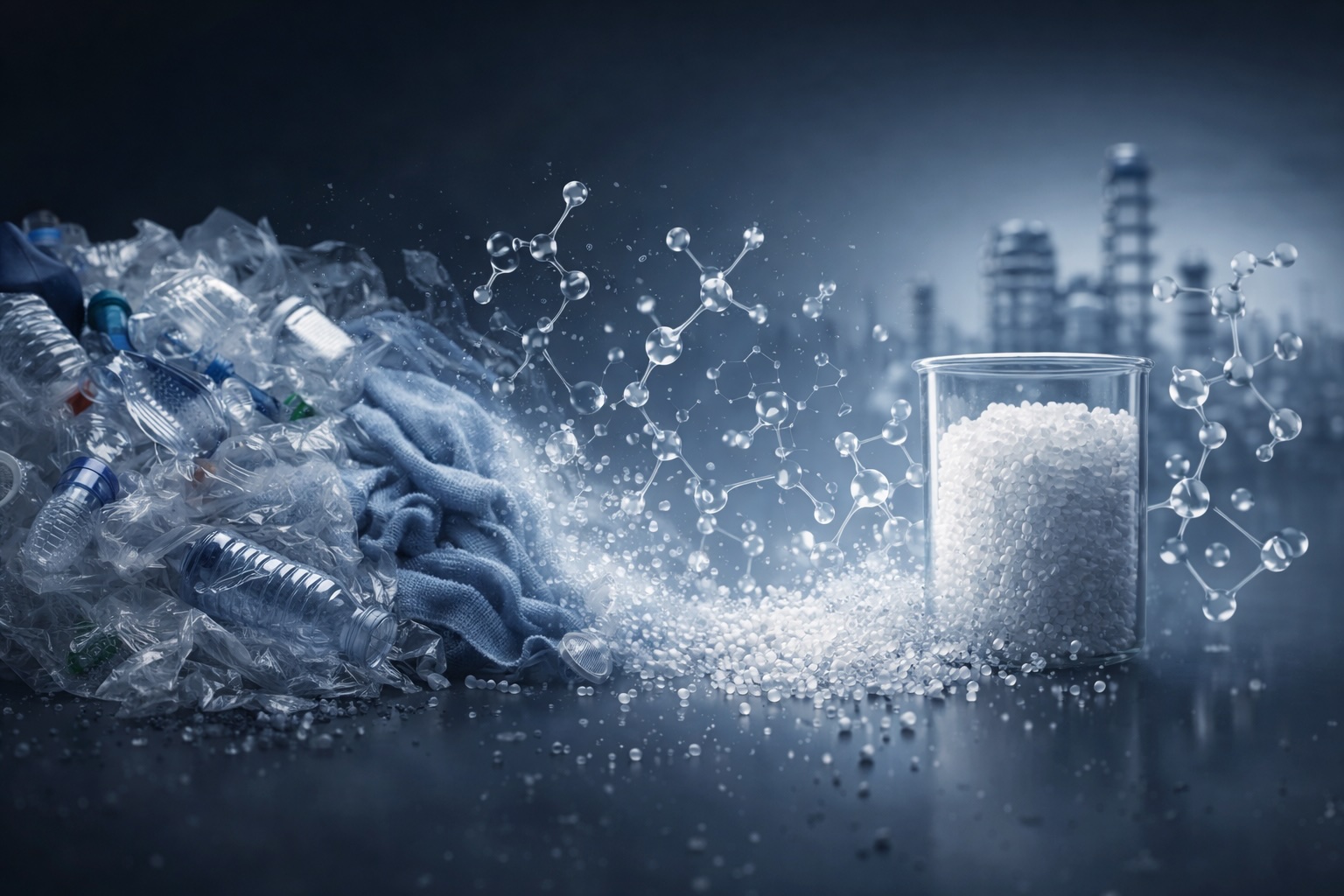
European industry is currently facing a combination of energy, resource and geopolitical uncertainty. Rising oil and natural gas prices are directly reflected in the cost of producing plastics, chemical feedstocks and fertilisers, while dependence on imports from unstable regions remains high. Paradoxically, Europe possesses its own source of carbon for the production of plastics and chemicals, which it largely fails to utilise – plastic waste.
The energy crisis of recent years has exposed a structural weakness in the European economy: a lack of domestic carbon sources for the chemical industry. Oil and natural gas are not only energy commodities but also fundamental building blocks of modern chemistry. Oil is used to produce aromatic compounds required for plastics, synthetic fibres and packaging materials. Natural gas is essential for ammonia production and, subsequently, nitrogen-based fertilisers. Any fluctuation in the prices of these inputs is immediately transmitted across the entire value chain – from petrochemicals to agriculture.
Fertilisers as a vulnerable link
Fertilisers represent a particularly sensitive segment. Their production is energy-intensive and closely tied to natural gas prices. During periods of high energy costs, production in Europe is often reduced, leading to increased dependence on imports. Limited availability or high prices of fertilisers are subsequently reflected in farmers’ costs and, ultimately, in food prices. Fertilisers are therefore no longer solely an industrial issue, but part of a broader discussion on food security.
Plastic waste as a source of raw materials
At the same time, Europe generates millions of tonnes of plastic waste every year. Polymers such as PET, widely used in packaging and textiles, contain a high proportion of valuable aromatic carbon. From a chemical perspective, this is not waste but a resource. Yet a significant share of this material is either used for energy recovery or exported outside the European Union. In doing so, Europe loses a potential source of carbon that could serve as a feedstock for the production of new plastics and chemical products. In the context of rising oil and natural gas prices, this is no longer merely a question of recycling, but of securing access to essential raw materials for the petrochemical industry.
Molecular recycling: returning to monomers
Molecular recycling technologies offer a fundamental shift in this approach. Instead of mechanical processing, which often leads to material degradation, they break polymers down into their basic chemical components. In the case of PET, these are primarily terephthalic acid (TPA) and monoethylene glycol (MEG), key monomers used in the production of new plastics and polyester fibres. These monomers serve as direct feedstock for new plastic production, replacing raw materials derived from oil while returning carbon back into the industrial cycle. When recovered at sufficient purity, they can fully substitute fossil-based inputs.
A practical solution: RECIVONE
One concrete example of this approach is the technology developed by RECIVONE. It utilises patented molecular recycling of post-consumer and post-industrial PET and PES waste, converting it back into base monomers of a quality comparable to primary production from fossil sources. These monomers provide direct feedstock for the production of new PET plastics and polyester fibres, enabling the return of aromatic carbon to the chemical industry, reducing dependence on imported fossil feedstocks, and stabilising the supply of key chemical inputs for plastics manufacturing.
This approach shifts the perception of plastic waste from waste management to resource strategy. Plastic is no longer viewed as an end-of-life problem but as a valuable input. In the context of Europe’s efforts to strengthen industrial autonomy, this represents a significant shift.
In addition to producing monomers for plastics manufacturing, this type of technology can also generate mineral outputs applicable in agriculture. This creates a link between the chemical industry and fertiliser production, potentially mitigating some of the impacts of volatile natural gas prices. However, this is not the primary benefit. The core value lies in returning carbon to the production of plastics and chemical materials through high-quality monomers.
At the same time, this approach is fully compatible with the long-term transformation of the chemical industry towards low-emission inputs, where the production of key process chemicals can increasingly be linked to renewable energy and green hydrogen.
New opportunities for the circular economy
The transformation of plastic waste into chemical feedstocks thus opens a pathway to reduce dependence on imported fossil resources, stabilise costs in the petrochemical industry, and support the principles of the circular economy. In an era of disrupted supply chains and rising oil and natural gas prices, this is no longer merely an environmental issue, but a question of Europe’s ability to secure its own resources for the production of plastics and chemical products.
Europe is not facing a shortage of carbon. The real question is whether it can effectively utilise the carbon it already has.
By Lenka Linhartova, Co-founder of RECIVONE